
For most retailers, a two-piece suit is the safer core stock because it sells across business, travel and daily formalwear. BOSINNO men’s suits support both two-piece and three-piece planning through MTM, RTW, wholesale and flexible co-line production, so buyers can test vest demand before building full inventory.
Der Hauptunterschied im two piece vs three piece suit sourcing is the vest. A two-piece suit includes a jacket and trousers. A three-piece suit adds a matching waistcoat.
That extra piece changes fabric use, cutting time, fit risk and retail purpose. A two-piece suit is easier to sell for daily businesswear. A three-piece suit feels more complete for weddings, formal events and premium office dressing.
For procurement teams, the vest needs the same shade, lining direction, buttons and balance as the jacket and trousers.
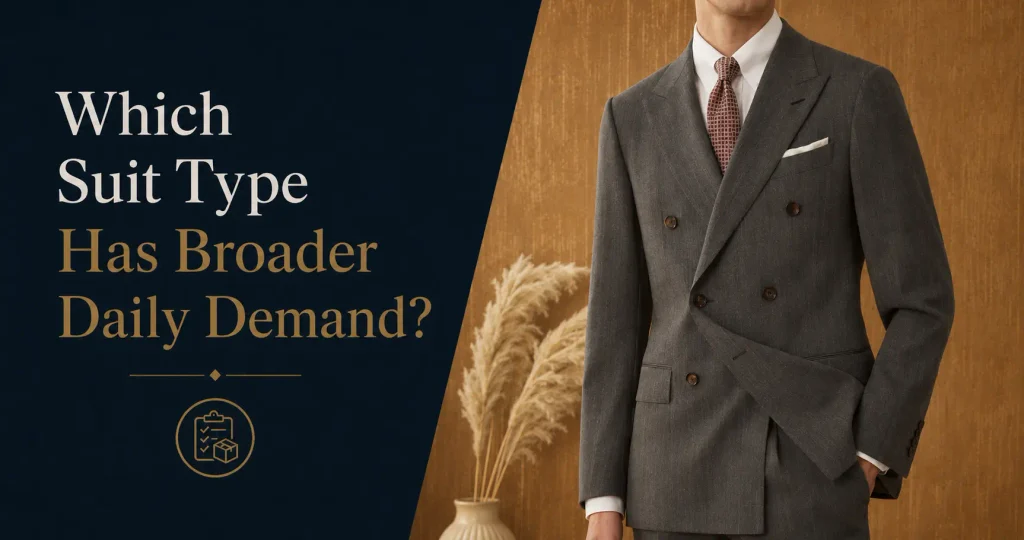
A two-piece suit usually has broader daily demand because customers can wear it for work, meetings, interviews and regular formal events. It is easier to style and usually easier to stock across sizes.
Two-piece suits also reduce one fit risk because a three-piece set adds waistcoat length, chest shape and waist control.
For businesswear planning, the Marine Mini-Fischgrät-Sakko mit Einreiher works as a two-piece reference because it pairs a notched-lapel jacket with matching trousers in one fabric blend.
Retailers should stock three-piece suits when customers buy for weddings, business photos, formal ceremonies or premium office wear. The waistcoat raises the perceived value and lets the outfit stay polished even when the jacket is removed.
Three-piece suits fit:
The risk is slower turnover, so the vest should be planned around clear demand.
A three-piece suit usually costs more because it needs extra cloth, lining, buttons, interlining, cutting and sewing time. The waistcoat also needs shade matching with the jacket and trousers.
| Cost Point | Two-Piece Suit | Three-Piece Suit |
| Pieces | Jacket and trousers | Jacket, trousers and waistcoat |
| Fabric use | Lower | Höher |
| Fit checks | Jacket and trousers | Full set balance |
| Stock risk | Lower | Höher |
| Retail use | Daily formalwear | Weddings and premium events |
Der three piece suit vs two piece decision should start with customer use, not only price. If buyers rarely ask for a waistcoat, stock the two-piece suit first.

Color-split orders lower inventory risk by separating the jacket, trousers and waistcoat plan instead of forcing every style into a full three-piece set. This approach helps retailers test which colors need waistcoats and which colors should stay as two-piece basics.
A practical split may look like:
For BOSINNO sourcing, an outerwear + trouser + waistcoat color-split plan can help buyers control fabric allocation, size spread and slow-moving vest inventory.
Flexible co-line production helps buyers develop related suit pieces on the same planning line, such as jackets, trousers and waistcoats that share fabric, trims and delivery timing.
For buyers testing both suit types, co-line planning can support one two-piece base style and selected waistcoat add-ons.
Buyers should check vest fit on the body before approving three-piece production. The vest should sit close without pulling, cover the waistband and lie flat under the jacket.
Check:
For a structured formal reference, the Grauer 3D-Textur-Fischgrät-Zweireiher-Anzug helps buyers review how jacket shape and matching trousers work before adding a waistcoat to a premium set.
A suit line works best when the stock plan follows real customer use. Keep two-piece suits as the base for daily businesswear, then add three-piece options for weddings, events and premium styles.
Before scaling, test one core color, one fabric and one waistcoat option first. If the two-piece suit sells steadily, keep it as core stock. If customers ask for a fuller formal set, add waistcoats through a smaller color-split order instead of committing to every color at once.

Schnelle Antwort: Warum knittert Leinen? Leinenanzüge knittern aufgrund der Faserstruktur. Flachsfasern sind steif und wenig elastisch, daher behalten sie eine Falte, anstatt zurückzuspringen. Ein Leinen-Woll-Mischanzug verlangsamt dies: Wolle sorgt für Elastizität und Rücksprungkraft, sodass Falten flacher sitzen und sich zwischen den Tragevorgängen entspannen. Eine Mischung […]

Schnelle Antwort Für Käufer, die marineblaue vs. anthrazitfarbene Anzüge vergleichen, lagern Sie zuerst marineblaue für die meisten Herrenmode-Sortimente, dann fügen Sie anthrazit hinzu. Marineblau wirkt geschäftsmäßig, passt zu mehr Hemden, Krawatten und Schuhen und wird von einer breiteren Kundengruppe gekauft. Anthrazit verkauft sich als zweites, für formelle, geschäftliche und kältere Jahreszeiten, wo ein ruhigerer, dunklerer Ton erwartet wird. Also […]

Schnelle Antwort Beim Vergleich von Leinen- vs. Wollanzügen beginnen Sie damit, wie sich jeder Stoff im Gebrauch verhält. Für warme Wetterbereiche bietet Leinen die kühlste Haptik und einen matten, texturierten Look, aber es knittert und erfordert klare Pflegehinweise. Wolle behält ihre Form, erholt sich schneller und deckt mehr Jahreszeiten ab. Ein Leinen-Woll-Mischanzug liegt zwischen den beiden […]
ADRESSE: No.2299 SHUANGTA ROAD,OUBEI,WENZHOU,ZHEJIANG,325102 ,CHINA


